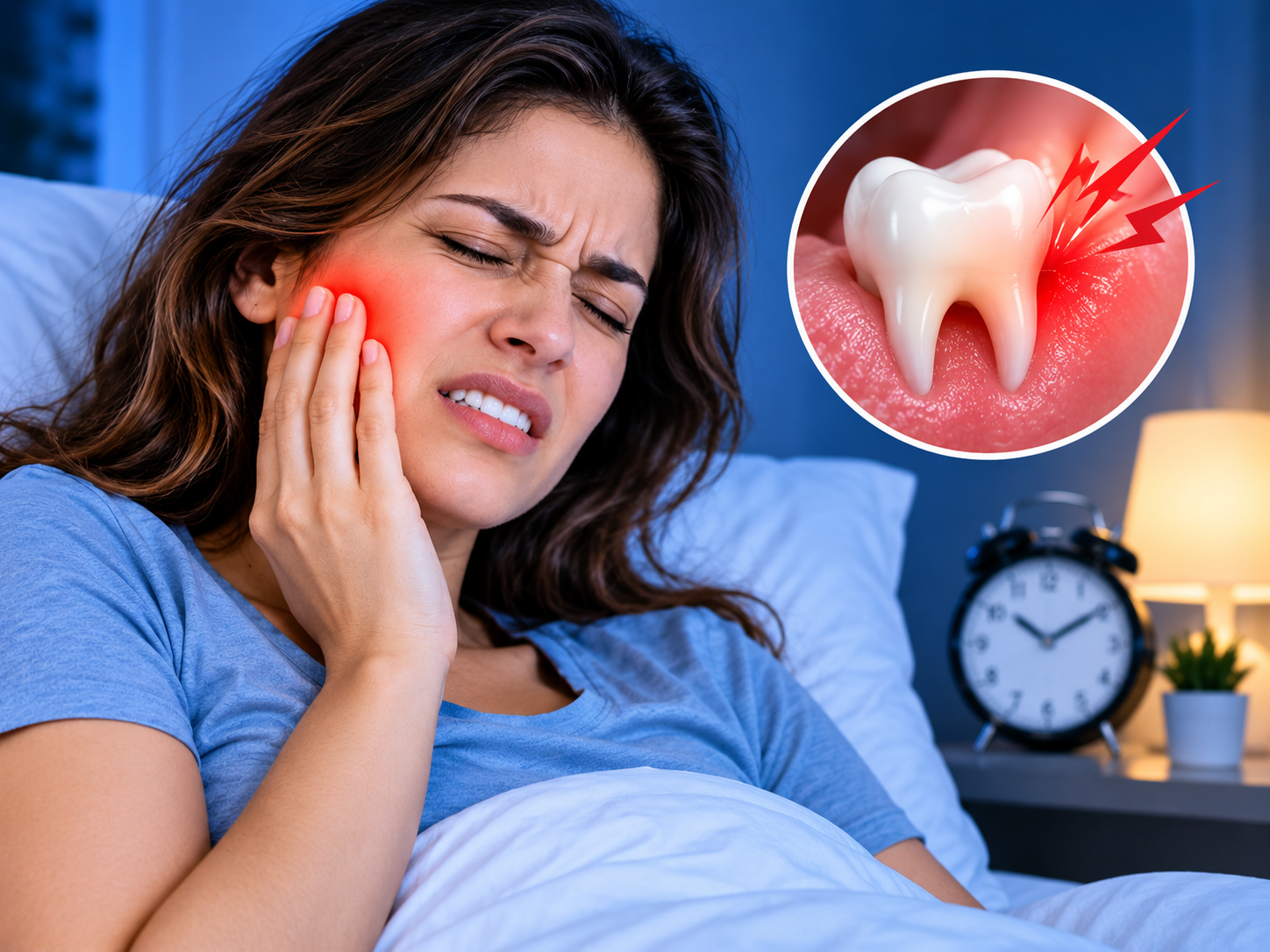
Severe tooth pain at night usually means something inside or around the tooth needs attention. This article covers why a toothache often gets worse after dark, what’s usually causing it, and which signs mean you need emergency dental care instead of waiting.
A tooth that only hurts at night can still be a serious problem. Often the pain is just harder to ignore once you lie down.
Why Does Tooth Pain Get Worse at Night?
Your tooth doesn’t know what time it is. But a few things change when you go to bed:
- You’re lying flat. More blood flows to your head, which adds pressure to an inflamed nerve.
- There’s nothing to distract you. Pain you tuned out during the day suddenly takes over.
- You grind or clench in your sleep. That puts heavy force on teeth that are already sore.
- Your sinuses fill up. Congestion can press on the roots of your upper back teeth.
So night pain isn’t a separate problem. It’s often the same problem, turned up.
Common Causes of a Toothache at Night
1. A Deep Cavity
Decay that reaches the inner layer of the tooth makes it sensitive to heat, cold, and sugar. Once it gets close to the nerve, it can start to throb on its own.
2. An Inflamed or Infected Nerve
When bacteria reach the pulp (the soft tissue inside the tooth), the nerve swells. Because it’s trapped inside hard enamel, the pressure has nowhere to go.
This kind of pain often comes on without a trigger and keeps you up.
3. A Tooth Abscess
An abscess is a pocket of infection, usually at the tip of the root or in the gum. It can cause deep, pounding pain, swelling, a bad taste, or a pimple-like bump on the gum.
An abscess won’t clear up on its own. It needs to be drained and treated.
4. A Cracked Tooth
A crack can be too small to see. You might feel a sharp pain when you bite down or release, or when you drink something cold.
Nighttime grinding can make a small crack worse.
5. Grinding and Clenching
If you wake up with sore teeth, a tired jaw, or a headache, you may be grinding in your sleep. Over time it wears teeth down and can lead to cracks.
6. Gum Infection
Gum disease and infections around a tooth can cause aching, bleeding, and swelling. Food stuck under the gum can do it too. See how we approach gum disease treatment.
7. A Wisdom Tooth Coming In
A wisdom tooth that’s partly through the gum can trap food and bacteria. The gum around it can get swollen and painful, especially at the back of the jaw.
8. A Sinus Infection
If several upper back teeth ache at once and you’re congested, your sinuses may be the cause. Pain that gets worse when you bend over is a common clue.
Warning Signs That Mean You Should Call a Dentist Soon
Not every toothache is an emergency. But call us within a day or two if you notice:
- Pain that wakes you up or keeps you from falling asleep
- Throbbing that lasts more than a day or two
- Sensitivity to hot or cold that lingers after you stop eating or drinking
- Pain when you bite down on one tooth
- A bump on the gum, or a bad taste that won’t go away
- A tooth that’s darker than the teeth next to it
- Pain that was bad and then suddenly stopped
That last one catches people out. When a nerve dies, the pain can fade while the infection keeps spreading.
When It’s a Dental Emergency
Get emergency dental care the same day if you have:
- Swelling in your gum, face, or jaw
- Severe pain that pain relievers don’t touch
- A knocked-out tooth or a badly broken tooth
- Bleeding that won’t stop
Go to the ER Instead If You Have:
- Trouble breathing or swallowing
- Swelling that spreads toward your eye or down your neck
- A high fever along with facial swelling
These can mean a serious infection that needs medical care right away.
What to Do Tonight While You Wait
These won’t fix the problem, but they can help you get through the night:
- Take an over-the-counter pain reliever and follow the dose on the label.
- Sleep with your head raised on an extra pillow to ease the pressure.
- Hold a cold pack on the outside of your cheek for 15–20 minutes at a time.
- Rinse with warm salt water to clean the area and calm the gums.
- Skip very hot, very cold, or sugary food and drinks before bed.
- Chew on the other side if you eat anything.
Don’t put aspirin directly on your gum. It can burn the tissue.
What Happens at Your Emergency Visit
When you come in, we’ll find out what’s actually causing the pain. Here’s what to expect:
- We talk through your symptoms. When it hurts, what makes it worse, and how long it’s been going on.
- We take digital X-rays. If we need a closer look at the roots and bone, we use our cone beam CT scanner.
- We explain what we found and walk you through your options and the cost before we start.
- We treat the pain. That might mean a filling, treating an infection, or removing a tooth that can’t be saved.
If you’re nervous about dental work, ask about IV sedation when you call.
Learn more about emergency dentistry at our office.
Treatments That Stop Tooth Pain for Good
Depending on what’s causing the pain, treatment may include:
- A filling for a cavity that hasn’t reached the nerve
- A crown to protect a cracked or weakened tooth. Our in-office milling machine lets us make some crowns the same day.
- Treating the nerve or infection to clear it out and save the tooth
- Removing the tooth if it’s too damaged to save. Here’s what to expect from oral surgery at our office.
- A night guard if grinding is behind the pain
If a tooth does need to come out, we’ll talk about replacing it, including dental implants.
Why You Shouldn’t Wait It Out
It’s tempting to take another pain pill and hope it goes away. Here’s what usually happens instead:
- A small cavity turns into an infected nerve
- An infection spreads into the bone around the tooth
- A tooth you could have saved ends up needing to come out
Antibiotics can calm an infection for a while. But they can’t clean out the inside of a tooth, so the pain usually comes back.
Emergency Dentist in Redding and Palo Cedro: Cost and Insurance
- Insurance: We accept Delta Dental and Cigna. We don’t accept HMO plans, Medicare plans, or Medi-Cal/Medicaid. We’ll check your benefits for you.
- Financing: CareCredit, Cherry, and Proceed Finance offer monthly payment plans.
- Payment: We take cash, personal checks, and most major credit cards.
See all your insurance and financing options.
Our offices:
- 2950 Eureka Way, Suite C, Redding, CA 96001 · (530) 222-0515
- 9461 Deschutes Rd, Suite 2, Palo Cedro, CA 96073 · (530) 547-5757
Quick Answers
Can a toothache at night go away on its own? Sometimes the pain fades, but the cause usually doesn’t. A cavity or infection keeps getting worse until it’s treated.
Why does my tooth only hurt when I lie down? Lying flat sends more blood to your head and adds pressure on an inflamed nerve. Sinus congestion can do the same thing to upper teeth.
Is a toothache with swelling an emergency? Yes. Swelling means an infection may be spreading. Call us the same day, or go to the ER if it’s spreading toward your eye or neck, or you have trouble breathing or swallowing.
Should I go to the ER for tooth pain? Only for the warning signs above. The ER can help with pain and serious infection, but you’ll still need a dentist to fix the tooth.
Conclusion
Severe tooth pain at night is usually caused by a cavity, an inflamed nerve, an abscess, a crack, or grinding, and lying down just makes it harder to ignore. Swelling, pain that wakes you up, or a bump on your gum are signs you need emergency dental care soon. Treating it early can often save the tooth and stop the pain for good.
Up at night with a toothache? Book an appointment or call our Redding office at (530) 222-0515 or Palo Cedro at (530) 547-5757. Have a question about your symptoms? Leave it in the comments, or explore the conditions we treat. For more click here