


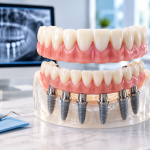
Dental Implants can provide a long term option for replacing missing teeth and restoring oral function. Dental Implants may be considered when individual teeth are missing, severely damaged, or no longer able to support a restoration. For people with multiple missing or failing teeth, Dental Implants can also form the foundation for a more comprehensive restoration plan.
When several teeth are affected, full mouth dental implants may be discussed as an alternative to replacing each tooth separately. Dental Implants can be strategically placed in the jaw to support replacement teeth, depending on bone health, oral condition, and the individual’s treatment needs.
Understanding how full mouth implants work, who may be a candidate, and what factors influence implant treatment can help patients have more informed discussions with their dental professional. Shasta Family Dentistry provides dental care information for patients considering different approaches to restoring their oral health.
What Are Full Mouth Dental Implants?
Full mouth dental implants are used to restore an entire arch or both arches when many teeth are missing or failing. Rather than placing an individual implant for every missing tooth, a treatment plan may use strategically positioned implants to support a fixed replacement dental arch.
The exact number and placement of implants depends on factors such as:
- Jawbone condition
- Number of remaining teeth
- Gum health
- Bite and jaw function
- Overall oral health
- Type of replacement teeth being considered
- Available bone volume
- Individual treatment goals
The term full mouth implants can describe several different approaches, so patients should ask their dentist what type of restoration is being recommended and why.
How Are Full Mouth Implants Planned?
Full mouth implant treatment requires detailed planning before implant placement. The dentist evaluates the condition of the teeth, gums, jawbone, bite, and surrounding oral structures.
Diagnostic imaging may be used to assess the available bone and identify important anatomical structures. The dentist can then develop a treatment plan based on the individual’s anatomy and restoration goals.
The planning process may involve:
- A comprehensive dental examination
- Review of medical and dental history
- Evaluation of remaining teeth
- Assessment of gum health
- Diagnostic imaging
- Evaluation of jawbone volume
- Discussion of restoration options
- Development of a customized treatment plan
This process helps determine whether implant treatment is appropriate and whether additional procedures may be needed before implant placement.
Why Does Bone Health Matter?
Dental implants rely on the jawbone for stability. After a natural tooth is lost, the bone surrounding the missing tooth can gradually change because it is no longer receiving the same stimulation.
Patients with insufficient bone may require additional treatment before implants can be placed. Depending on the situation, bone grafting or other procedures may be considered.
Bone health is only one part of the assessment. Gum health, oral hygiene, medical history, and other factors can also affect the suitability of dental implants.
A dental examination is therefore necessary before determining whether full mouth dental implants are an appropriate option.
Who May Consider Complete Dental Implants?
Complete dental implants may be considered for people who have extensive tooth loss or multiple teeth that are severely compromised.
Potential situations include:
- Numerous missing teeth
- Extensive tooth damage
- Advanced tooth wear
- Teeth that cannot be predictably restored
- Significant problems affecting several teeth
- Difficulty functioning with existing removable dentures
- A desire for a fixed tooth replacement option
However, the presence of multiple failing teeth does not automatically mean that all teeth should be removed and replaced with implants. A dental professional must evaluate which teeth can potentially be preserved and which may require extraction.
Preserving healthy natural teeth can be beneficial when they have a reasonable long term prognosis.
What Are the Potential Benefits?
One reason patients consider full mouth implants is that they can provide support for fixed replacement teeth. Depending on the treatment design, the resulting restoration may be more stable than traditional removable dentures.
Potential benefits can include:
- Improved chewing function
- Greater stability than removable options
- Replacement of multiple missing teeth
- Support for a fixed restoration
- Restoration of the appearance of the smile
- A treatment approach designed around the individual’s oral anatomy
The results depend on the patient’s oral health, treatment plan, implant integration, restoration design, and ongoing maintenance.
Dental implants are not a guarantee of a particular outcome, and patients should discuss expected benefits and limitations with their dentist.
What Happens If Teeth Are Failing but Not Yet Missing?
Patients with failing teeth may wonder whether they should remove them immediately and replace them with implants. In many cases, the answer requires careful evaluation.
A tooth may be compromised but still treatable through restorative procedures. Depending on its condition, treatments such as crowns, root canal therapy, periodontal treatment, or other restorative approaches may help preserve it.
On the other hand, teeth with extensive structural damage, severe infection, or poor long term prognosis may require extraction.
The decision should be based on the condition and prognosis of each tooth rather than assuming that all failing teeth should be removed.
What Is the Recovery Process Like?
Recovery after implant surgery varies depending on the number of implants placed and whether additional procedures are performed.
Some patients experience temporary swelling, tenderness, bruising, or sensitivity after treatment. The initial soft tissue healing period is generally shorter than the time required for the implant to integrate with the surrounding bone.
Osseointegration is the process through which the implant becomes integrated with the jawbone. This can take several months and is an important stage of implant treatment.
During recovery, patients may receive instructions regarding:
- Oral hygiene
- Diet
- Physical activity
- Medication
- Temporary restorations
- Follow up appointments
Following the dentist’s instructions can help support the healing process.
Can Cosmetic Dentistry Be Combined With Implant Treatment?
In some cases, restorative treatment may be planned alongside cosmetic dental procedures. The goal is to create a balanced result that considers tooth shape, color, proportions, gum appearance, and overall smile aesthetics.
Patients interested in cosmetic considerations can also learn about smile dental design and how cosmetic planning may address the appearance of the smile.
However, cosmetic treatment and implant treatment serve different purposes. Dental implants primarily replace missing tooth roots and support restorations, while cosmetic procedures focus on the appearance of existing teeth and the smile.
What Factors Determine Whether Full Mouth Implants Are Right for You?
There is no single treatment that is appropriate for every patient. A dentist may consider several factors before recommending full mouth implants.
These can include:
- The number of missing teeth
- Condition of remaining teeth
- Gum health
- Jawbone condition
- Oral hygiene
- Bite and jaw function
- Medical history
- Ability to maintain the restoration
- Treatment expectations
The dentist may also discuss alternatives and explain the advantages and limitations of each approach.
Final Thoughts
Full mouth dental implants may be an option for patients with extensive tooth loss or multiple failing teeth, but suitability depends on individual oral health and treatment requirements. Dental Implants can provide support for fixed replacement teeth, but successful treatment requires careful planning, healthy supporting tissues, appropriate implant placement, and long term maintenance.
Patients should not assume that every failing tooth needs to be removed or that full mouth implants are automatically the best solution. A comprehensive evaluation can help determine whether natural teeth can be preserved and which replacement options may be appropriate.
If you are considering dental implants or want to understand your options for missing or failing teeth, Contact us to discuss your dental needs and the next steps in evaluation.
Frequently Asked Questions
Q1. Are full mouth dental implants suitable for everyone?
No. Suitability depends on factors such as jawbone health, gum condition, remaining teeth, oral hygiene, medical history, and individual treatment needs. A dental evaluation is required to determine whether implants are appropriate.
Q2. How many implants are needed for a full mouth restoration?
The number varies depending on the treatment design, jaw anatomy, bone condition, and type of restoration being supported. Your dentist can determine the appropriate number during treatment planning.
Q3. Can failing natural teeth be replaced with full mouth implants?
They may be, but extraction is not always necessary. A dentist should evaluate each failing tooth to determine whether it can be predictably restored or whether replacement may be appropriate.
Q4. How long does full mouth implant treatment take?
Treatment time varies depending on the patient’s oral health, need for extractions or bone grafting, implant healing, and restoration process. Some treatments can involve several stages over an extended period.
Q5. How do I care for dental implants after treatment?
Dental implants require regular brushing, cleaning between teeth, professional dental care, and routine examinations. Maintaining healthy gums around the implants is important for long term oral health.